Skip to content
ClausIQ EDU · for agricultural schools

The agriculture 4.0 lab, in your school.

IoT sensors in the woodland, the greenhouse and the urban garden, computer vision stations and a single platform installed at the school. Turnkey, with ready-made teaching materials for teachers.

3measurement environments: woodland, greenhouse, town
13 + 1IoT sensors and a weather station, each with its own SIM
7vision systems with an AI accelerator
8ready-made teaching modules for teachers
1platform, installed at the school
Why ClausIQ EDU

The same tools used by agriculture 4.0 farms.

ClausIQ is the platform UpToEarth uses every day to collect data from sensors, weather stations and vision systems in table grape vineyards in Puglia. ClausIQ EDU brings the same technology into the classroom: students collect real data, turn it into agronomic indicators, train models on images and make technical decisions based on data, just like on a real farm.

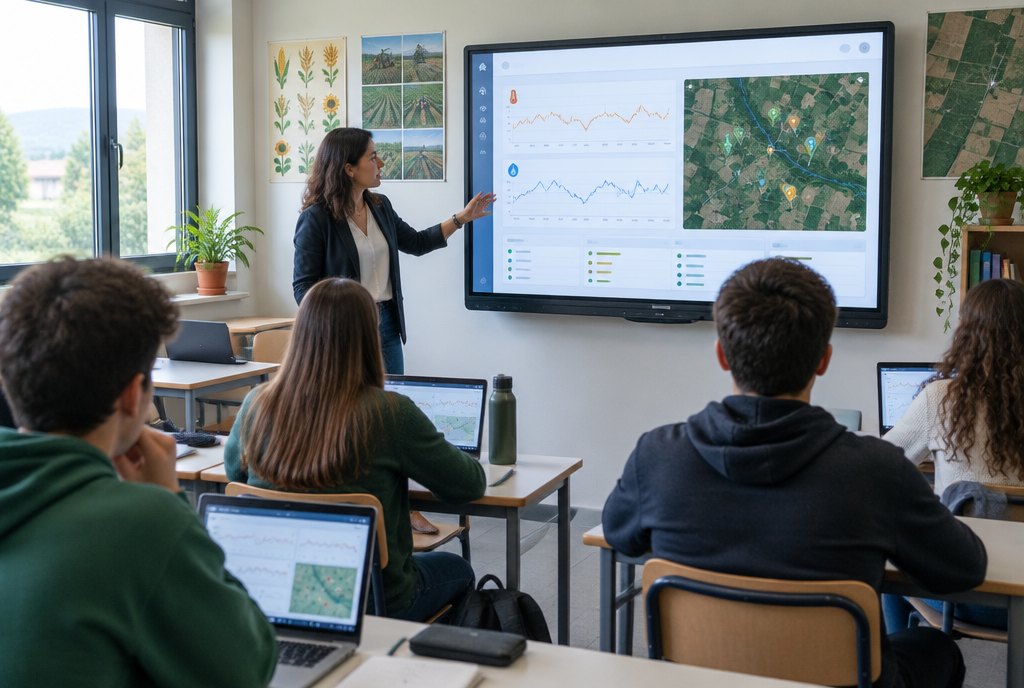
Lezione in aula con la dashboard dei dati (immagine generata con AI)
1 · IoT monitoring network

Three environments, real data, all year round.

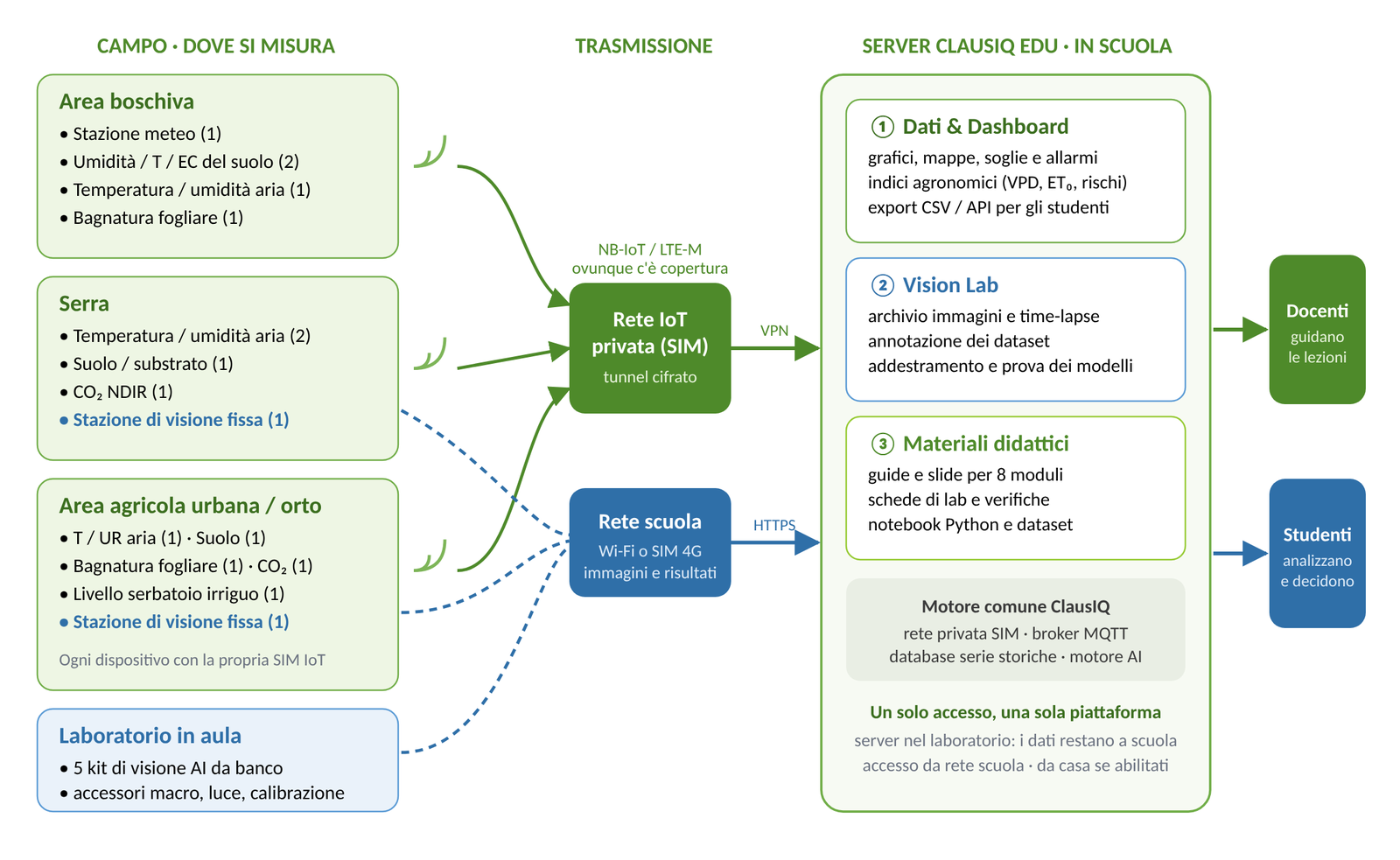
Each sensor has its own IoT SIM and transmits over the low-power mobile network: no gateway, no cables, it works wherever there is coverage, even in woodland far from the school. Battery or solar powered.

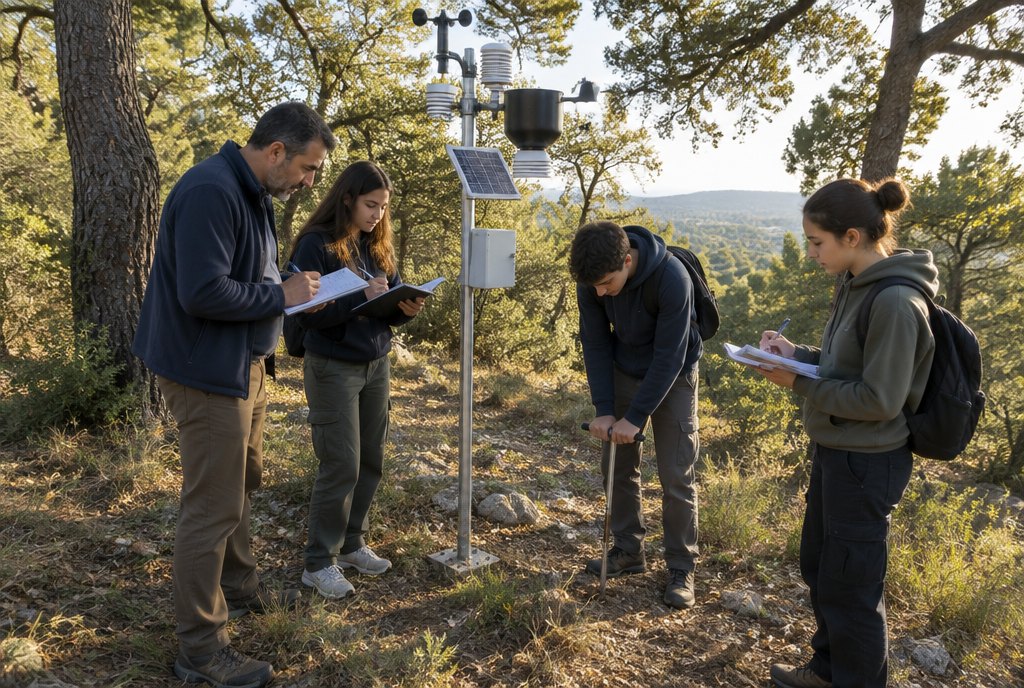
Woodland area

Woodland area

What is measured: weather station, soil moisture and temperature, air, leaf wetness.

What students study: forest microclimate, soil water balance, fire risk index, woodland vs open field comparison.
School greenhouse

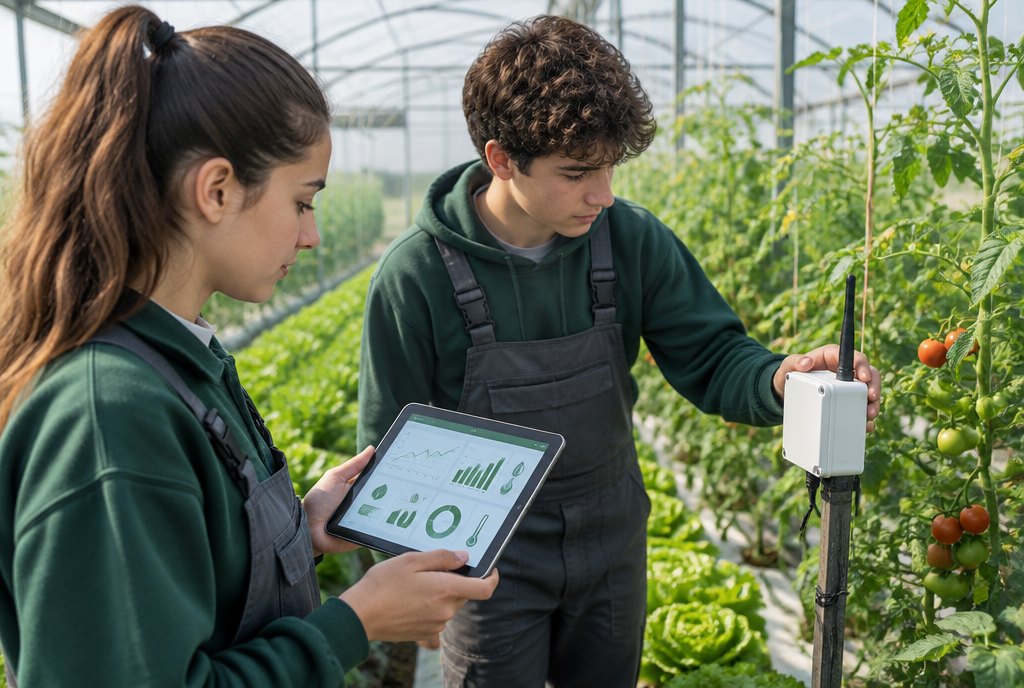
School greenhouse

What is measured: air temperature and humidity, growing medium, CO₂, plus a fixed vision station.

What students study: climate management in protected crops (VPD, dew point, ventilation), CO₂ and photosynthesis, time-lapse growth.
Urban farming area

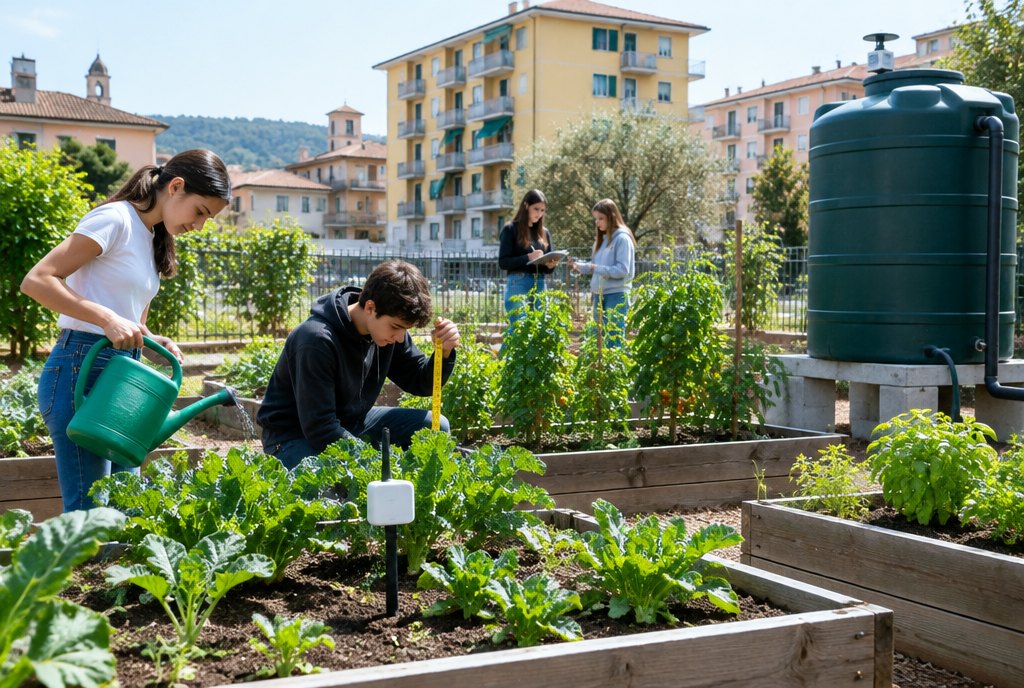
Urban farming area

What is measured: air, soil, leaf wetness, CO₂, tank level, plus a fixed vision station.

What students study: urban heat island, air quality, precision irrigation with a monitored tank, disease risk.
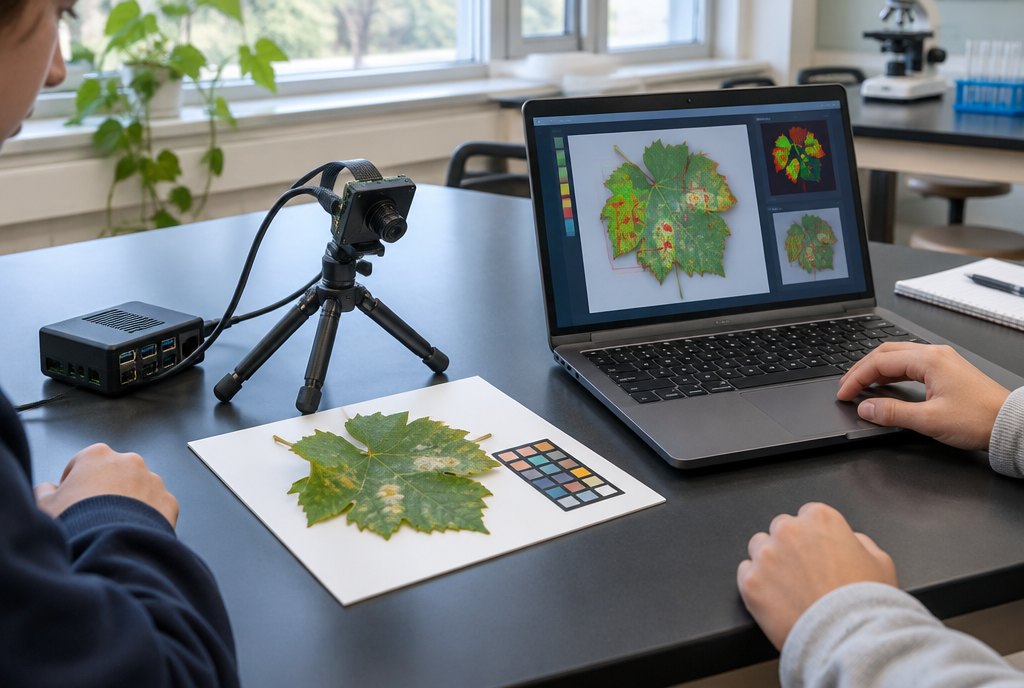
Kit di visione artificiale da banco che analizza una foglia (immagine generata con AI)
2 · Computer vision

From photo to recognition.

5 bench kits for classroom exercises and 2 fixed stations in the greenhouse and the urban garden, taking images at scheduled intervals. Each system has a 13 TOPS AI accelerator: the models trained by students run directly on the device, in real time.

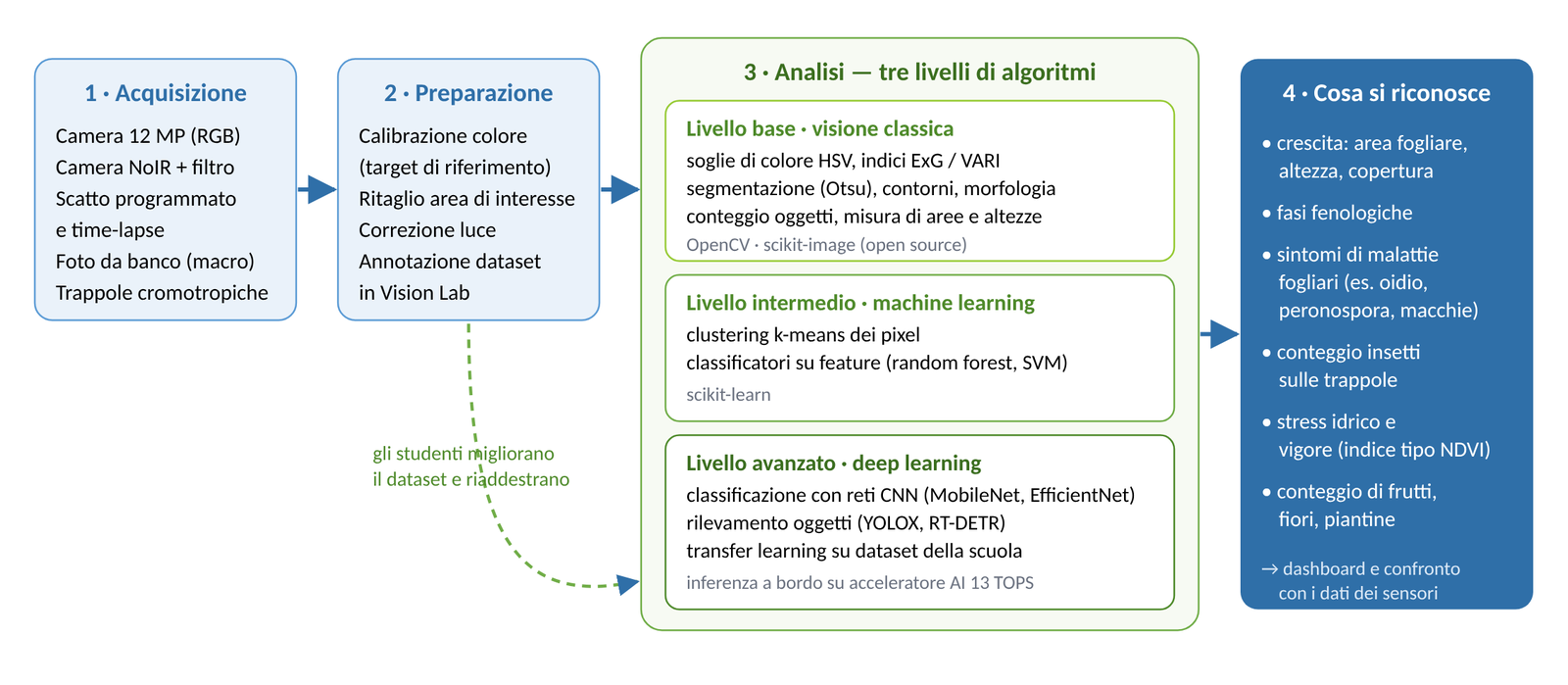
Basic level · classical visionColour thresholds, vegetation indices, segmentation, contours, measuring areas and heights.
Intermediate level · machine learningPixel clustering and feature-based classifiers (random forest, SVM).
Advanced level · deep learningNeural networks to classify and detect objects, trained on the class dataset.

What the class learns to recognise

Plant growth

Time-lapse from the fixed station: leaf area, canopy cover and height over time, with green segmentation.

Leaf diseases

Healthy and diseased leaves classified with neural networks and transfer learning, on school and public datasets.

Insects on traps

Photos of sticky traps: insect counting and recognition with object detection models.

Stress and vigour

NoIR camera with filter for an NDVI-type vegetation index, index calculation and thresholds.

Phenology and counts

Growth stages, counting flowers, fruits and seedlings.

The computer vision pipeline
The computer vision pipeline · diagram in Italian · click to enlarge
3 · ClausIQ EDU platform

One login, one platform. At the school.

Accessible from the browser on PCs, tablets, interactive whiteboards and smartphones, with nothing to install on the devices. Data can be downloaded as CSV or read via API, to work on it with spreadsheets, Python or any tool the teacher chooses.

Data & Dashboard

Real-time and historical charts, device map, thresholds and alarms, agronomic indices, comparison between environments, CSV export and API.

Vision Lab

Archive of station images and time-lapses, annotation tools, model training and testing.

Installed at the school

It runs on a school-owned server in the lab: sensor and image data stay at the school.

Secure by design

Sensor SIMs sit in a private network connected to the server through an encrypted tunnel: no ports opened on the firewall.

Access from home too

From the school network and, if the school wishes, from home for authorised teachers and students.

Open source only

OpenCV, scikit-learn, PyTorch, YOLOX, RT-DETR, Label Studio, WireGuard: no third-party licences to pay, now or at renewal.

How the lab works: from the field to the school server
How the lab works: from the field to the school server · diagram in Italian · click to enlarge
Learning path

8 modules, from data to decision.

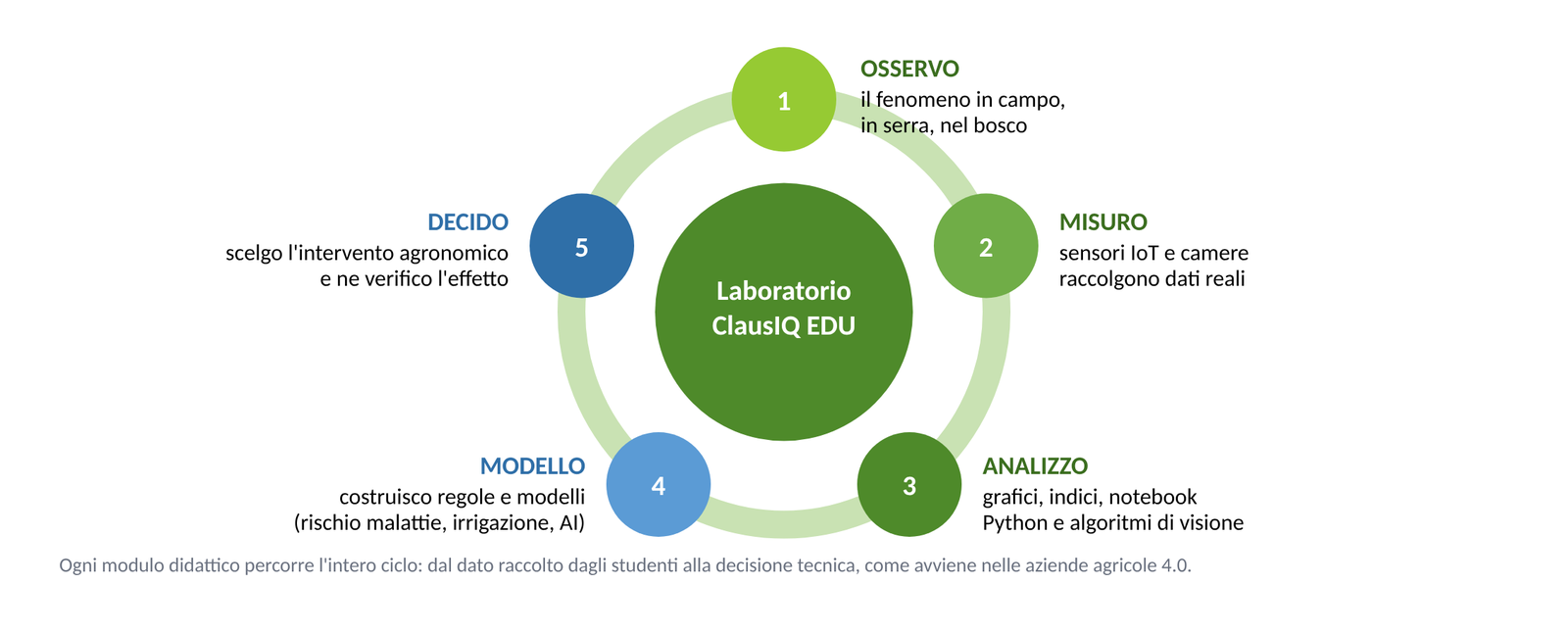
For each module the teacher receives a complete guide: they can study it, adapt it and run the lesson as they prefer. Every module follows the same cycle: observe, measure, analyse, build a model, decide.

1

Sensors and IoT networks: from phenomenon to data

Physical quantities, cellular IoT networks (NB-IoT / LTE-M), data quality and validation.

2

The greenhouse microclimate

VPD, dew point, ventilation and climate management in protected crops.

3

The woodland as a system

Soil moisture, woodland vs open field, fire risk index.

4

Urban farming and air quality

CO₂, heat island, ecosystem services of urban green spaces.

5

Precision irrigation

Evapotranspiration from the weather station, water balance, monitored tank.

6

Computer vision 1: the digital image

Colour, vegetation indices, segmentation, measuring growth.

7

Computer vision 2: neural networks

Annotating, training and evaluating a model for diseases and insects.

8

Risk models and alerts

Fungal infection models, combining sensors and images.

The learning cycle of each module
The learning cycle of each module · diagram in Italian · click to enlarge
Turnkey

We take care of everything.

  • Site survey and installation plan, including mobile coverage checks in the woodland
  • IoT network installed and working: weather station and 13 sensors with active SIMs
  • 5 pre-configured bench vision kits and 2 fixed vision stations installed
  • ClausIQ EDU server at the school, with a perpetual licence; updates and remote support included for 12 months
  • Complete teaching materials for 8 modules, adaptable by teachers
  • User manual, technical sheets, training for teachers and technical assistants
  • Labels for publicity obligations and support during acceptance testing
Available on MEPAOffer structured in separate items (devices, server, licences, labour, publicity), easy to report.
Ready in 8 weeksFrom contract signature to a working, tested lab.
Everything stays with the schoolServer, devices and data belong to the school; licences are perpetual.
Real technologyThe same as ClausIQ, which already monitors table grape vineyards in Puglia.
Add-on modules

A lab that grows with the school.

ClausIQ EDU is an open system: over time you can add modules that use the same platform and the same data, also available separately.

VR simulator IN DEVELOPMENT

On Meta Quest 3S headsets: agronomic operations, farming techniques, woodland and wildfire monitoring, with levels for different ages.

Virtual classroom in the metaverse

A shared 3D space, in the browser and in a headset, for immersive lessons, meetings with experts and exchanges with other schools.

ESP32 water quality kit

pH, turbidity, conductivity and temperature, logged to microSD, with a manual to replicate the kit in class.

More sensors, more environments

New nodes for vineyard, orchard, olive grove or pond, connected to the same platform.

Extra vision kits

More bench kits or fixed stations, for smaller groups or more environments.

Satellite remote sensing

Sentinel-2 images of the school plots with NDVI and NDWI, to compare with sensors and ground images.

Day in the field

A precision agriculture demonstration in a vineyard with the patented CLAUS robot and our technologies, with guided activities for classes.

Local AI agronomy assistant

An assistant that answers questions on the lab data, with open-source models running on the school server.

Contact us

Let’s talk about your school’s lab.

  • We show you the lab live, at your school or by video call
  • We check spaces, network coverage and funding timelines together
  • You receive the full technical offer

Prefer to talk right away? Call us on +39 392 135 7855 or write to contact@uptoearth.eu.